
Written by Michelle Garcia, RN | Founder, Trusted Nurse Advocates
Updated 9/11/2026
For many families, senior care becomes difficult not because one task is impossible, but because every task is connected to ten others. Appointments, medications, transportation, home safety, insurance questions, and family communication can quickly turn into a full-time project. Strong care coordination for seniors brings those moving parts into one plan so older adults can receive safer, more consistent support while families make decisions with less guesswork.
A senior care manager, also called an elder care manager, geriatric care manager, or care coordinator, can help organize that plan. The goal is not to replace doctors, family members, or caregivers; it is to help everyone work from the same information, priorities, and next steps.

What does better care coordination look like for seniors?
Better care coordination means an older adult’s medical care, daily support, home environment, medications, and family communication are managed as one connected picture instead of separate problems. It may include sharing updates between providers, preparing for hospital discharge, arranging transportation, reviewing medication routines, connecting to community resources, and helping family members understand what needs attention now versus later.
This matters because many seniors live with ongoing health needs. The National Institute on Aging notes that about 85% of older adults have at least one chronic health condition, and 60% have at least two, which makes clear communication and follow-through especially important. When several providers, prescriptions, and care settings are involved, a missed detail can affect safety, comfort, independence, and confidence at home. (nia.nih.gov)
Care coordination also helps reduce the “who is handling this?” problem. One adult child may be scheduling appointments, another may be paying bills, a spouse may be managing pills, and a home care aide may notice daily changes. Senior care management gives those observations a practical structure, so concerns can be documented, shared, and acted on before they become crises.
The role of a senior care manager
A senior care manager is often a health or human services professional who helps families navigate aging-related care decisions. The Aging Life Care Association describes these professionals as guides and advocates for families caring for older relatives or disabled adults, and its public policy language defines aging life care management as planning and coordinating care to address problems, improve quality of life, and support independence. (aginglifecare.org)
In everyday terms, the care manager becomes a practical bridge between the older adult, family, medical team, paid caregivers, community services, and sometimes legal or financial professionals. They may attend appointments, ask clarifying questions, translate care instructions into a usable home plan, or help compare care options when needs change.
A senior care manager may support:
- Health care organization: Tracking providers, appointments, follow-up tasks, test results, referrals, and care instructions.
- Medication routines: Helping families maintain accurate medication lists, watch for confusion, coordinate refills, and raise concerns with clinicians or pharmacists.
- Home safety: Identifying fall risks, mobility barriers, nutrition concerns, driving worries, or signs that more support is needed.
- Caregiver planning: Matching daily needs with realistic family availability, home care schedules, respite options, and backup plans.
- Communication: Keeping authorized family members updated and helping reduce conflicting messages.
- Transitions: Preparing for moves between hospital, rehab, home, assisted living, or skilled care settings.
The best care managers are both organized and observant. They know that a new fall, missed meal, unpaid bill, or changed mood may signal a deeper issue. Rather than treating each event as isolated, they look for patterns and help the care team respond in a coordinated way.
Care coordination turns scattered tasks into a living plan
A useful care plan is not a binder that sits on a shelf. It is a working document that changes as the older adult’s health, abilities, preferences, and support system change. In case management for seniors, that plan should connect medical needs with daily realities: Can the person get to appointments? Do they understand medication changes? Is food available? Is the home safe after surgery? Who notices if something changes?
This is where geriatric case management becomes especially valuable. A physician may identify a diagnosis, a physical therapist may recommend exercises, and a family caregiver may notice that the exercises are not happening because the senior is afraid of falling. A care manager can bring those pieces together, ask for clarification, and help create a realistic routine.
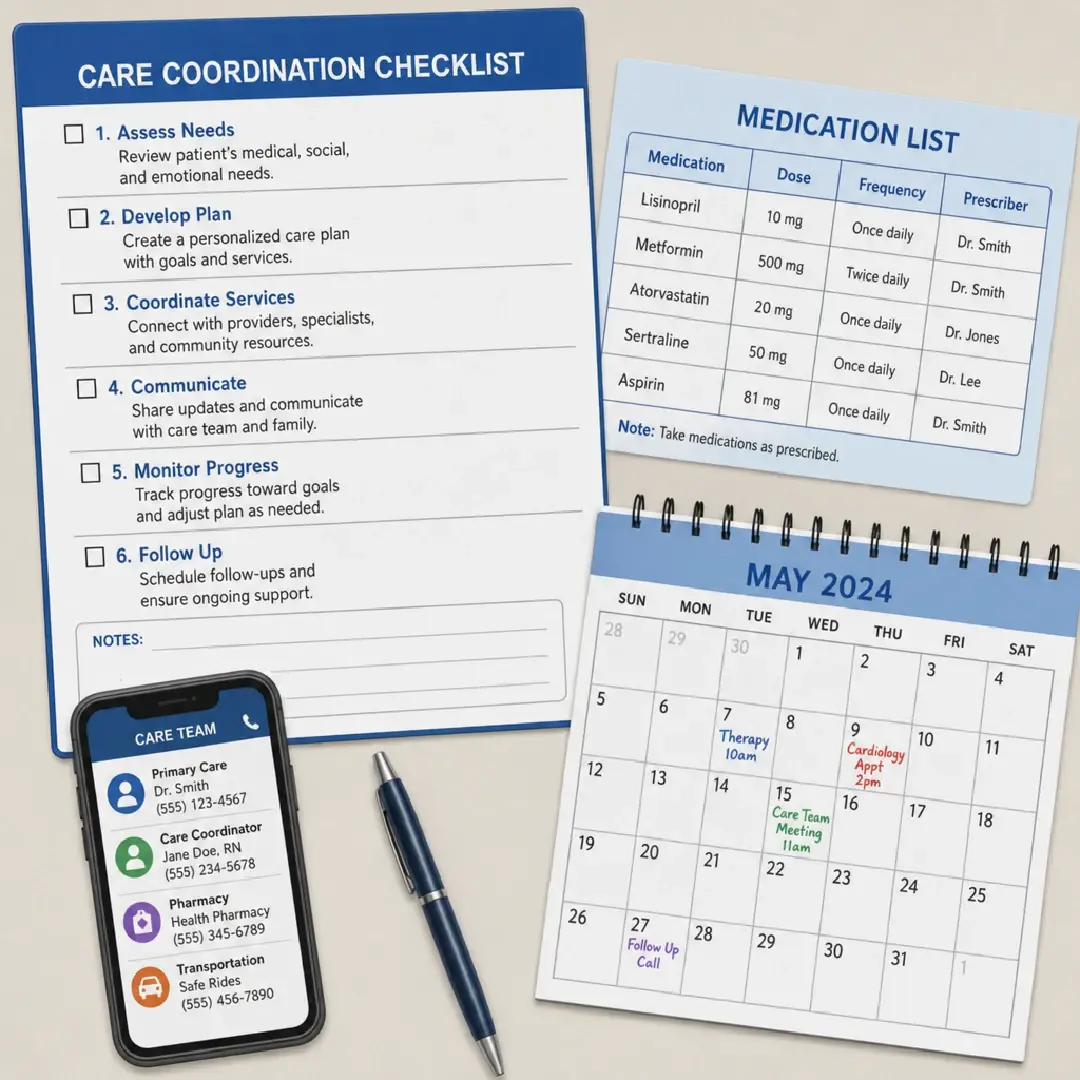
Strong senior case management often includes a cycle of assessment, planning, coordination, monitoring, and adjustment. The first plan is rarely the final plan. A senior who was safe alone six months ago may now need medication reminders, transportation support, or help bathing. A spouse who was managing well may become exhausted. A new diagnosis may shift priorities overnight.
How can senior care management improve safety and quality of life?
Senior care management can improve safety and quality of life by identifying risks early, helping older adults follow care instructions, supporting medication organization, and making it easier for families and providers to act on the same information. It also supports independence by matching the level of help to the person’s actual needs rather than waiting for a crisis to force a rushed decision.
For example, an older adult may be hospitalized after a fall and discharged with new medications, therapy instructions, and follow-up appointments. Without coordination, the family may not know which medication was stopped, whether the home needs grab bars, or who is arranging transportation to therapy. A care manager can help review discharge papers, confirm follow-up tasks, communicate with home care, and flag questions for the medical team.
Medication management deserves special attention
Medication problems are common in complex care because instructions can change after hospitalizations, specialist visits, or pharmacy substitutions. A geriatric care manager does not replace a prescribing clinician, but they can help maintain an accurate list, encourage one pharmacy when appropriate, support refill routines, and prompt the family to ask about side effects or interactions.
Practical medication coordination may include:
- Comparing the current medication list with recent discharge or visit instructions.
- Noting duplicate bottles, expired medications, or confusing labels.
- Helping set up pill organizers, reminder systems, or pharmacy packaging.
- Encouraging the family to ask a pharmacist or clinician about possible interactions.
- Tracking missed doses or symptoms that should be reported.
The benefit is not just convenience. When medication routines are clearer, seniors are more likely to follow instructions safely, and families are more likely to notice when something does not seem right.
Family caregivers gain structure and relief
Care coordination is also emotional support, even when it looks like logistics. Families often carry a heavy mental load: remembering appointments, watching for decline, mediating disagreements, and worrying from work or from another state. A private care manager can provide professional eyes on the situation and help families decide what to prioritize.
This can be especially helpful for long-distance caregivers. If an adult child lives hours away, they may only see a parent during short visits, when the parent is trying to appear more independent than they are. The National Institute on Aging describes long-distance caregivers as people who live an hour or more away from someone who needs care, and encourages them to gather information, coordinate local help, and stay involved in care decisions. (nia.nih.gov)
Private, community-based, and clinical care managers each serve different needs
Not every care manager works in the same setting. Understanding the differences helps families choose the right type of support.
A private care manager is usually hired directly by the older adult or family. This person may provide broad support across medical coordination, home care planning, housing decisions, family meetings, and crisis response. Private geriatric care management is often useful when needs are complex, family members disagree, or no one nearby can monitor the situation consistently.
A clinical case manager may work for a hospital, health system, insurer, home health agency, or Medicare Advantage plan. Their role is usually connected to a specific episode of care, benefit, diagnosis, or care setting. They may help with discharge planning, referrals, covered services, or care transitions, but their scope can be limited by the organization they work for.
A community-based care coordinator may be connected to an Area Agency on Aging, nonprofit organization, Medicaid waiver program, senior center, or local service network. This type of support can be especially helpful for meals, transportation, caregiver programs, benefits navigation, and aging-in-place resources.
The right option depends on the senior’s situation. A family may use more than one type of support at the same time, such as a hospital case manager for discharge planning and a private elder care manager for longer-term home coordination.
Medicare care coordination and coverage basics
Medicare care coordination can cover certain services when eligibility rules are met, but families should not assume that every care management service is paid for by Medicare. Medicare.gov lists several ways care may be coordinated, including chronic care management, transitional care management, behavioral health integration, principal care management, and community health integration services. (medicare.gov)
For chronic care management, Medicare Part B may pay when a person is eligible, and Medicare describes the service as including a comprehensive care plan with health problems, goals, providers, medications, and needed community services, along with access for urgent care needs. (medicare.gov) Transitional care management may be covered by Medicare Part B for eligible patients returning to the community after certain inpatient stays, such as a hospital or skilled nursing facility stay. (medicare.gov)
Medicare Advantage plans may also offer care coordination or case management, but benefits, networks, prior authorization rules, and supplemental supports vary by plan. CMS has described Medicare Advantage supplemental benefits that may address needs such as food insecurity or transportation, but families should confirm what is available in the specific plan and service area. (cms.gov)
PACE, the Program of All-Inclusive Care for the Elderly, is another important model for some seniors. Medicare describes PACE as a Medicare and Medicaid program available in some states that provides comprehensive medical and social services and may cover all Medicare- and Medicaid-covered care, plus other services the PACE team determines are needed. (medicare.gov)
If a family is considering a private care manager, ask directly about fees and coverage. Private senior care management is often paid out of pocket, though some long-term care insurance policies or specialized benefits may help in certain situations. Coverage rules change and vary, so it is wise to verify with the insurer, plan documents, and the care manager before services begin.
When families should consider a geriatric care manager
A geriatric care manager can be helpful before a crisis, but many families wait until stress is already high. The earlier support begins, the easier it is to build a plan around the senior’s preferences rather than reacting to emergencies.
Consider senior case management when:
- A parent has multiple chronic conditions and several specialists.
- Medications are frequently changed, missed, duplicated, or misunderstood.
- Family members disagree about care decisions or roles.
- The senior has had repeated falls, hospital visits, or emergency calls.
- A spouse caregiver is exhausted, ill, or becoming overwhelmed.
- The older adult lives alone and safety is becoming uncertain.
- Adult children are coordinating from a distance.
- A move to assisted living, memory care, rehab, or home care is being discussed.
- The senior’s needs are changing faster than the family can organize support.
These signs do not always mean a major move is needed. Sometimes the right answer is a modest change: better medication setup, more transportation support, a home safety evaluation, or clearer communication between providers. The value of an elder care manager is helping families sort those options in the right order.
Need Help Coordinating Your Care?
If you have Medicare in New York and are managing multiple chronic conditions, medications, doctors, appointments, hospital follow-up, or barriers to getting the care you need, Trusted Nurse Advocates may be able to help.
Our nurse-led care management team helps patients and families organize the moving pieces of healthcare and stay connected with the resources and support they need.
A practical transition scenario
Imagine an 82-year-old living alone who is discharged home after a short hospital stay. She has a new diagnosis, two medication changes, a walker, home health orders, and a follow-up appointment in one week. Her daughter lives out of state, and her son lives nearby but works long hours.
Without coordination, several things can go wrong. The senior may restart an old medication by mistake, miss the follow-up appointment, avoid using the walker, or decline home health visits because she does not understand why they were ordered. Family members may assume someone else has handled the details.
With senior care management, the process becomes more deliberate:
- The care manager reviews discharge instructions with the senior and authorized family.
- Medication questions are documented for the prescribing clinician or pharmacist.
- Follow-up appointments and transportation are confirmed.
- Home risks are noted, such as loose rugs, poor lighting, or stairs.
- Home care, therapy, meals, and family check-ins are coordinated.
- The family receives updates, including concerns that need medical attention.
This does not eliminate every risk, but it creates a clearer path. Everyone knows what changed, what is scheduled, what warning signs matter, and who is responsible for the next step.
How to choose and work with a care manager
Choosing a care manager is partly about credentials and partly about fit. Families should look for someone with relevant aging-care experience, a clear service scope, transparent fees, and strong communication habits. Ask how they coordinate with physicians, home care agencies, senior living communities, and family members.
Useful questions include:
- What is your background in nursing, social work, gerontology, counseling, rehabilitation, or related fields?
- Do you specialize in dementia, chronic illness, complex family situations, hospital transitions, or aging in place?
- How do you assess needs and create a care plan?
- How often do you communicate with family members, and in what format?
- Do you provide emergency or after-hours support, and what are the limits?
- How are fees charged, and what services are included or separate?
- Do you have professional affiliations, standards, or references the family can review?
Once hired, make the relationship effective by sharing complete information. Provide medication lists, provider names, insurance details, advance directives if available, emergency contacts, and the senior’s own goals. A good care plan should reflect not only safety needs, but also preferences: staying near friends, keeping a pet, attending worship services, gardening, or remaining at home as long as reasonable.
Free Advance Care Planning Toolkit
Planning ahead can make future healthcare decisions easier for you and your family. Download Trusted Nurse Advocates’ free toolkit to help organize your healthcare wishes and important information.
The real value is continuity
The strongest care coordination for seniors is not a one-time fix. It is an ongoing habit of noticing changes, updating plans, clarifying responsibilities, and keeping the older adult at the center of decisions. Whether support comes from a private care manager, clinical case manager, community program, or a mix of resources, the goal is the same: fewer gaps, better communication, and care that fits real life.
For families, senior care management can turn uncertainty into a more manageable process. It gives loved ones a clearer view of what is happening, what support is available, and what decisions need to be made next. Most importantly, it helps seniors receive care that respects both their health needs and their desire for dignity, safety, and independence.
Frequently Asked Questions About Care Coordination for Seniors
What is care coordination for seniors?
Care coordination helps organize an older adult’s healthcare needs into one connected plan. This can include medications, doctors and specialists, appointments, hospital follow-up, transportation, home services, community resources, and communication with family members.
Who may benefit from senior care coordination?
Older adults with multiple chronic conditions, several specialists, frequent medication changes, recent hospitalizations, repeated falls, or changing needs at home may benefit. It can also be helpful when family caregivers are overwhelmed or live far away.
Can care coordination help after a hospital stay?
Yes. Care coordination can help organize discharge instructions, medication questions, follow-up appointments, transportation, home care, therapy, and other needs after someone returns home.
Can a care manager help with medications?
A care manager can help maintain an accurate medication list, identify confusion that needs to be addressed, support medication routines, and coordinate questions with the appropriate clinician or pharmacist. They do not replace the prescribing provider or pharmacist.
Does Medicare cover care coordination?
Medicare covers certain care-management and coordination services for eligible beneficiaries when the specific requirements are met. These can include Chronic Care Management and Transitional Care Management. Not every private care-management service is covered, so eligibility and coverage should be verified for the individual.
How do I know if my parent needs a care manager?
It may be time to consider additional support when medications are becoming confusing, appointments are being missed, there are repeated falls or hospital visits, several providers are involved, a caregiver is becoming overwhelmed, or your parent’s needs are changing faster than the family can manage them.
Michelle Garcia, RN, is a Registered Nurse with 28 years of healthcare experience, including emergency nursing, long-term care, case management, nursing leadership, education, and patient advocacy. As the founder of Trusted Nurse Advocates, Michelle is passionate about helping older adults, people living with chronic conditions, and their families navigate complex healthcare needs, coordinate care, access resources, and remain as safe and independent as possible. trustednurseadvocates.com
Need Help Navigating Your Healthcare?
Managing your health can become overwhelming, especially when you are dealing with chronic conditions, multiple medications, specialists, appointments, insurance questions, and finding the right resources.
You don’t have to make important healthcare decisions or navigate the system on your own. Trusted Nurse Advocates provides nurse-led care management to help you understand your care plan, coordinate your healthcare needs, connect with providers and resources, and know what steps to take next.
Have Medicare? You may qualify for care management services. We work with eligible Medicare beneficiaries, including individuals with Original Medicare and participating Medicare Advantage plans.
Reach out today for a free consultation and let us help guide you every step of the way.
[Schedule a Free Consultation →]
Coverage and eligibility vary by Medicare plan and individual circumstances. Contact Trusted Nurse Advocates to verify eligibility and available services.